

Coworking Space for Entrepreneurs in Bali: Build a Business Remotely
Bali has transitioned from a temporary vacation destination into a primary global hub for long-stay entrepreneurs, startup founders, and independent business owners.
The island offers a competitive cost of living, a growing professional network, and an attractive climate. However, establishing and scaling a remote business requires more than a standard internet connection and an open workspace. For an entrepreneur managing international clients, cross-border teams, or venture-backed projects, operational efficiency is the determining factor between stagnation and growth.
When operating a business from a foreign territory like Bali, minor administrative and domestic friction points can quickly accumulate. Issues such as unstable residential Wi-Fi, power outages, and the logistics of managing daily household chores subtract from an executive’s finite cognitive capacity.
To maximize productivity, successful remote entrepreneurs prioritize all-inclusive coworking hubs that absorb these low-value operational tasks.
Among these conveniences, integrated long-stay amenities, such as onsite laundry access and comprehensive administrative support, serve as critical infrastructure that allows founders to protect their schedules and maintain absolute focus on core business development.
The Opportunity Cost of Domestic Logistics in Remote Operations
For a startup founder or corporate executive, time allocation is a zero-sum game. Every hour spent managing basic household maintenance is an hour lost on product development, investor relations, client acquisition, or strategic planning.
In a traditional corporate environment, secondary logistics are abstracted away by facility managers and administrative staff. In a remote setup, the responsibility often falls back on the individual.
In Bali, standard domestic management can introduce unexpected operational drag:
- Transit and Delivery Management: Coordinating with external vendors for laundry, grocery delivery, or equipment repair requires constant scheduling, communication via messaging applications, and physical presence to receive items.
- Unpredictable Turnaround Times: External local laundry services frequently operate on variable schedules influenced by weather conditions, public holidays, or local religious observances. For an entrepreneur with a rigorous travel or presentation schedule, this lack of predictability introduces unnecessary operational risk.
- Cognitive Load: The mental energy required to track minor domestic tasks contributes directly to decision fatigue, lowering an executive’s overall output during high-stakes business hours.
By selecting a workspace that integrates these services directly into the physical office infrastructure, entrepreneurs can run a lean, highly efficient daily routine.
Criteria for Evaluating Long-Stay Entrepreneurial Workspaces
When establishing a business base in Bali for six months or longer, founders must evaluate potential coworking hubs through an operational lens.
The following criteria outline how to assess a space based on infrastructure capability, schedule optimization, and long-term asset protection.
1. Onsite Service Integration and Continuous Workflow
A premium entrepreneurial workspace should function as a comprehensive ecosystem. The presence of professional onsite services, such as a dedicated concierge, mail handling, and laundry facilities, allows members to execute a seamless daily workflow.
Dropped-off garments should be processed silently in a separate wing of the facility to ensure that commercial-grade washers and dryers do not create acoustic interference in dedicated focus zones or private meeting rooms. This setup allows an entrepreneur to arrive in the morning, delegate routine tasks to the house staff, and work uninterrupted until their daily objectives are achieved.
2. Geographic Positioning and Traffic Mitigation
Bali’s primary commercial corridors, specifically Canggu, Berawa, Seminyak, and Kerobokan, experience high levels of traffic congestion during peak business hours. Commuting across town to manage separate work, dining, and domestic errands is highly inefficient.
An ideal coworking hub should be positioned within immediate proximity to major transit loops, residential areas, and banking services.
A central location ensures that team members and clients can access the facility without navigating narrow, bottlenecked residential corridors (gangs), preserving billable hours and reducing daily transit fatigue.
3. Turnaround Speed and Schedule Predictability
In global business environments, schedules are subject to rapid change. An entrepreneur may need to prepare for an unexpected investor meeting, a last-minute business trip to a regional hub like Jakarta or Singapore, or an unplanned video consultation with enterprise clients.
Therefore, a workspace’s internal service velocity must meet professional standards. Hubs that offer guaranteed same-day or next-morning turnaround for domestic services provide the level of predictability required to manage a corporate schedule without friction.
4. Verification of Operational Reliability Through Peer Metrics
Before committing to a long-term corporate or individual membership, entrepreneurs should audit the reputation of a coworking space using verified historical data. General tourist reviews often emphasize aesthetic elements, social activities, or casual cafe food.
In contrast, business operators must look for feedback from other long-stay professionals regarding internet uptime, power redundancy (backup generators), data security, and the reliability of facility staff.
Consistent positive metrics from other enterprise users confirm that the facility operates with the necessary professionalism to handle sensitive corporate presence.
5. Hardware Standards and Asset Protection
Remote professionals often travel with high-value technical wardrobes designed for tropical corporate presentation, networking galas, and media appearances. Entrusting these assets to low-end or unregulated laundry facilities introduces the risk of chemical damage, shrinking, or loss.
Entrepreneurs should verify that the coworking space utilizes professional-grade, modern machinery with precise temperature control and programmable cycles.
High-performance hardware guarantees that technical fabrics, formal wear, and premium materials are preserved correctly, eliminating the costs and distractions of replacing specialized clothing while living abroad.
6. Material Specialization and Professional Presentation
Maintaining a professional appearance is essential for building credibility with international clients and investors, even within a remote environment. A high-tier workspace service must demonstrate competency in managing diverse fabric types, such as silk, wool, performance activewear, and structured corporate linen.
Facilities that provide specialized care, including professional pressing and ironing services, ensure that an executive’s wardrobe remains crisp and presentable for sudden video conferences or high-level local networking events.
7. Cost Control, Corporate Deductions, and Single-Invoice Accounting
From a corporate accounting perspective, managing multiple micro-transactions for workspace access, printing, meeting room rentals, coffee, and domestic services is inefficient. It complicates expense tracking and increases administrative overhead for internal bookkeeping teams.
A professional coworking space solves this by offering comprehensive bundle pricing or all-inclusive monthly subscriptions.
Consolidating all operational and lifestyle expenses into a single monthly commercial invoice simplifies corporate deductions, clarifies operational overhead, and allows remote entities to track their accurate cost-of-presence metrics in Bali.
8. Transitioning to Founder-Focused Professional Ecosystems
The true value of an elite coworking hub lies in its community demographic. While many spaces target short-term tourists or entry-level freelancers, spaces optimized for long-stay infrastructure naturally attract seasoned business operators, funded startup teams, and specialized consultants.
Sharing a facility with other founders creates an environment of peer accountability and corporate focus. The shared common areas, executive lounges, and structured networking forums within these premium spaces regularly serve as incubation points for cross-border joint ventures, capital raises, and strategic B2B partnerships.
Operational Comparison Matrix for Long-Stay Frameworks
| Operational Parameter | Traditional Villa Setup | External Public Vendors | Integrated Coworking Hub |
| Internet Reliability | Variable; dependent on local residential ISPs. | Non-existent or insecure public networks. | Enterprise-grade fiber with dual-provider redundancy. |
| Time Allocation Overhead | High; requires direct supervision of local staff. | High; involves daily transit and pick-up logistics. | Zero; managed seamlessly by onsite facility concierge. |
| Expense & Billing Tracking | Fragmented across multiple utility and cash receipts. | Numerous cash-only, unitemized transactions. | Consolidated into one monthly corporate invoice. |
| Acoustic and Focus Control | Subject to neighborhood noise and domestic disruptions. | High background decibels; unsuited for business calls. | Enforced quiet zones and sound-isolated phone booths. |
| Professional Network Access | Isolated; limited to existing digital contacts. | Transient; primarily casual tourist interactions. | Direct access to established remote founders and capital pools. |
Mitigating Executive Decision Fatigue Through Structured Routines
The psychological strain of running a growing business is well-documented. Entrepreneurs must process complex legal, financial, and product decisions daily. Human cognitive capacity is finite; when an executive expends mental energy on minor domestic logistics, their capacity for critical strategic thinking decreases.
A structured routine supported by comprehensive workspace infrastructure minimizes this friction. By outsourcing facilities management, utility upkeep, and basic personal logistics to a trusted corporate vendor, an entrepreneur clears their daily schedule of secondary choices.
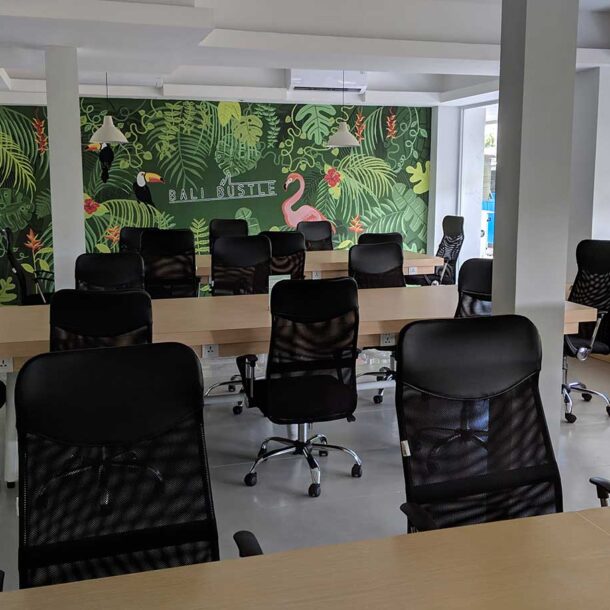
Arriving at a workspace like Bali Bustle where physical comfort, technical connectivity, and personal logistics are managed automatically creates the optimal psychological environment for sustained strategic output.
Frequently Asked Questions (FAQs)
How does domestic service integration within a workspace directly improve business output?
It removes the burden of coordinating vendors and managing deliveries, allowing entrepreneurs to focus more time on core business activities.
Are all-inclusive monthly workspace packages tax-deductible for remote businesses?
In many jurisdictions, comprehensive coworking memberships, private office rentals, and associated operational expenses can be categorized directly as legitimate business overhead or corporate travel expenses. Founders should consult with their certified public accountants (CPAs) to structure these single-invoice payments for maximum tax efficiency.
How can a business operator ensure data privacy when working from an integrated hub?
Premium coworking spaces designed for entrepreneurs provide enterprise-grade network security, including encrypted Wi-Fi access codes, virtual local area networks (VLANs) for private offices, and physical security measures like keycard access and CCTV monitoring. This infrastructure protects proprietary business data far better than residential villas or standard commercial cafes.
Why is geographic positioning critical when selecting a long-stay workspace in Bali?
Bali’s localized traffic can cause severe delays during mid-day and evening hours. Selecting a centrally located hub that sits near key arterial roads ensures that transit times are predictable, allowing business owners to move between residential quarters, corporate offices, and client dinners with minimal scheduling friction.

Bali Bustle Team shares practical insights about coliving, coworking, and remote work lifestyle in Bali, based on the brand’s experience managing community-driven living and working spaces in Bali.